3 Pneumatic Rock Drill Types: A Complete Classification Guide
Тanya
Table of Contents
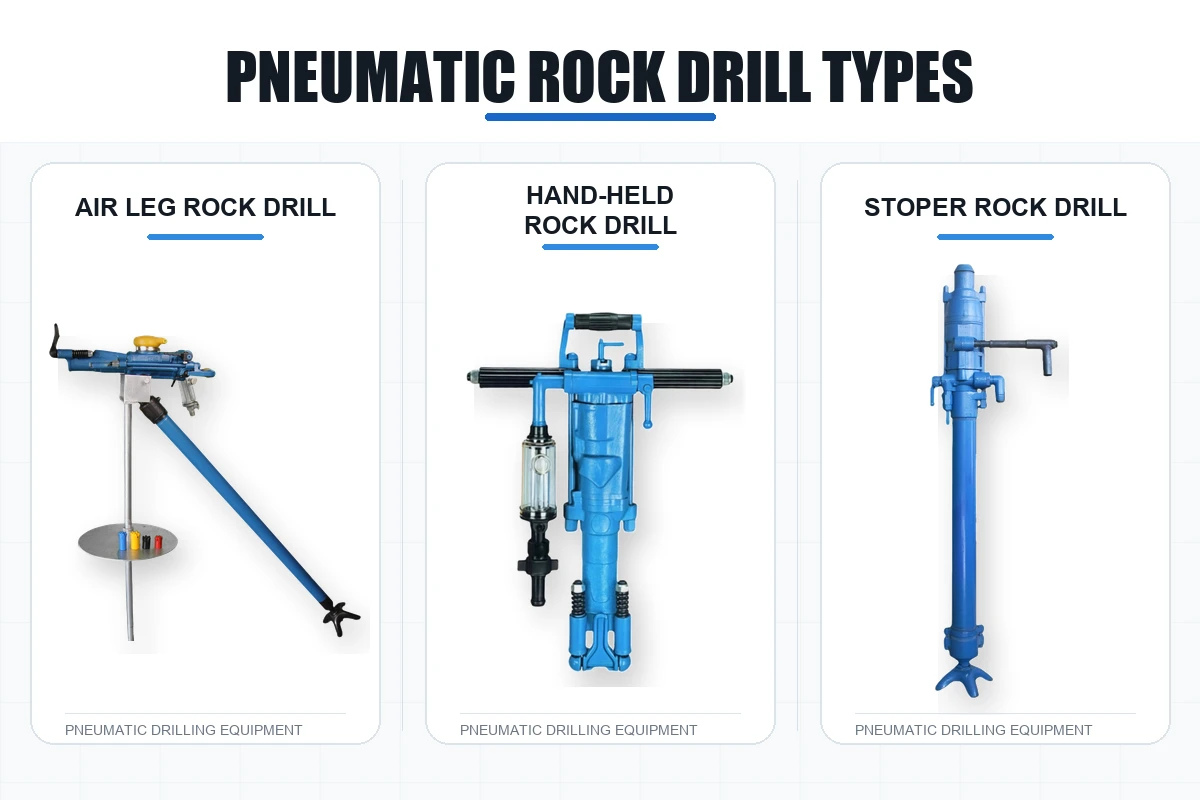
Pneumatic rock drill types split into three families — handheld, air-leg and stoper — and what separates them is how the machine is held against the rock, not how much impact energy it delivers. A handheld model such as the Y6 or Y20LY relies on the operator for thrust, which keeps it in the 6–26 kg class and limits it to short holes and tight access. An air-leg rock drill such as the YT28 or YT29A carries an FT leg underneath; that leg is what makes continuous 34–45 mm holes possible in tunnel and roadway drivage. A stoper such as the YSP45 pushes itself upward into the roof for the 60°–90° holes that neither of the other two can hold.
All three run on compressed air at 0.4–0.63 MPa (4–6.3 bar) and share the H22 × 108 mm shank. This guide compares every pneumatic rock drill in the range by weight, length, hole diameter, piston bore and air demand, then maps each type to the work it is bought for.
One machine is deliberately left out. The YN27C is a petrol-driven rock drill, not a pneumatic one, so it does not belong in a classification of pneumatic types. If your site has no compressor at all, that is the machine you want instead — see the internal combustion rock drill.
1. How Are Pneumatic Rock Drill Types Classified?
Most buyers mix up the axes and end up comparing machines that are not interchangeable. Keep them separate:
Axis
Options
What it determines
Support method
Handheld / air-leg / stoper
How thrust is applied, and therefore how deep and how straight you can drill
Drilling direction
Downward–horizontal / upward 60°–90°
Whether the machine can hold itself against gravity
Power class
Piston bore 58–95 mm · hole 20–45 mm
Penetration rate, and the hole sizes the machine can carry
Weight follows from these three, not the other way round. The catalogue runs from 6 kg to 44 kg, and that spread exists because the jobs differ, not because the engineering does. These pneumatic rock drill types should therefore be compared by support, direction and hole capacity before individual model specifications. Every machine in the range runs on compressed air at 0.4–0.63 MPa — that is the constant, not a variable.
2. Handheld Rock Drills: 6 kg to 26 kg
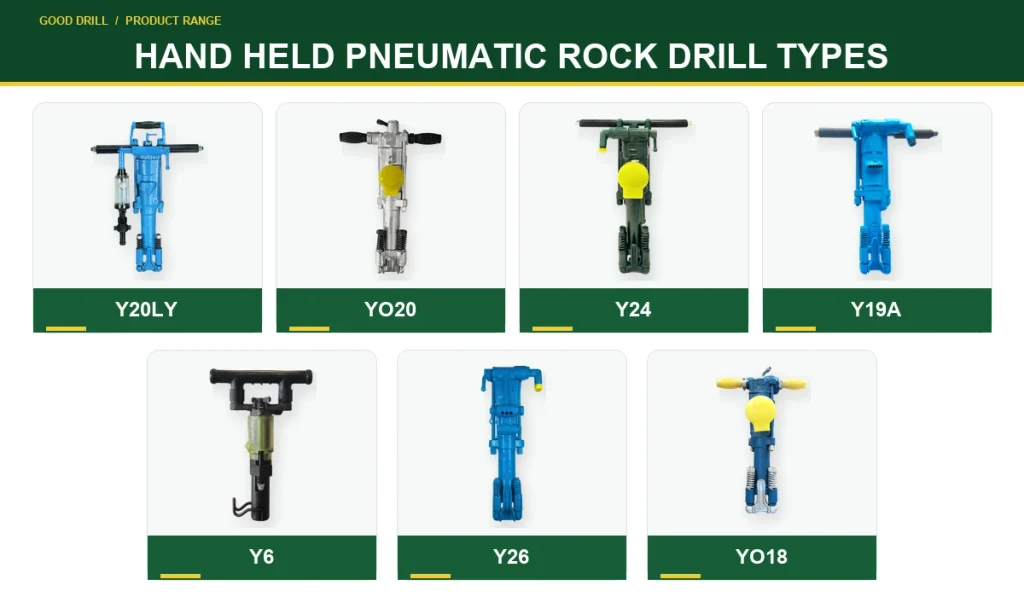
Among the three pneumatic rock drill types, handheld models are the most portable because the operator carries the machine and supplies the thrust. That makes them suitable for short holes and restricted access, but it also puts them below the air-leg class in continuous drilling duty.
Model
Weight (kg)
Length (mm)
Hole dia. (mm)
Piston dia. (mm)
Stroke (mm)
Air hose (mm)
Y6
6
426
20
70
60
19
YO18
18
550
34–40
58
45
19
Y20LY
18
609
34–40
60
50
16 / 19
Y19A
19
600
34–40
65
54
19
YO20
20
561
34–40
63
55
19
Y24
24
604
34–42
70
70
19
Y26
26
650
34–42
65
70
19
All models run on compressed air at 0.4–0.63 MPa (4–6.3 bar) — Y19A and YO18 top out at 0.5 MPa — and all use the H22 × 108 mm shank.
The Y6 is a different tool. At 6 kg with a 20 mm capacity it is not a scaled-down mining drill — it is for anchor and plug holes where nothing larger fits.
The 24–26 kg models are the practical ceiling. Y24 and Y26 weigh as much as several air-leg models and carry the same 70 mm piston as the YT24. What they lack is the leg: the operator holds the machine and absorbs the recoil. Fine for short holes and awkward positions, not for a full shift of production drilling.
Handheld models win on access — quarry edge trimming, secondary breaking, anchor bolts, and confined spaces a leg cannot reach.
3. Air-Leg Rock Drills: The YT Series
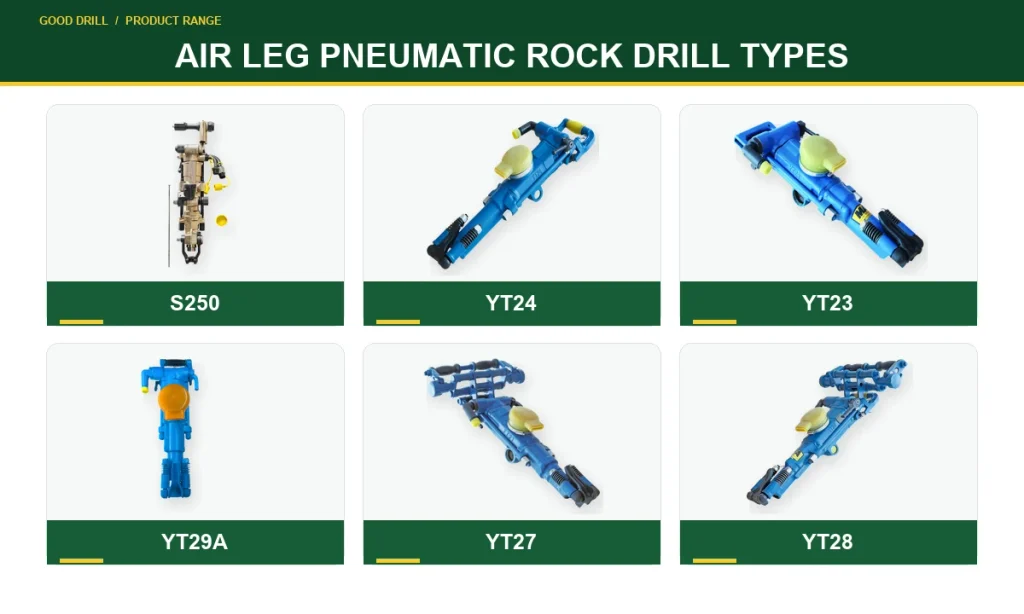
Of the three pneumatic rock drill types, the air-leg design is built for sustained horizontal and inclined drilling. It uses a percussion unit mounted on a separate pneumatic leg; the leg supplies thrust, so the operator guides rather than pushes.
Model
Weight (kg)
Length (mm)
Hole dia. (mm)
Piston dia. (mm)
Stroke (mm)
Air hose (mm)
YT23
24
628
34–42
76
55
25
YT24
24
675
34–42
70
70
19
YT28
26
661
34–42
80
60
25
YT27
27
668
34–45
80
60
25
YT29A
27
659
34–45
82
60
25
The YT28 and YT29A carry the largest pistons — 80 mm and 82 mm — and reach 34–45 mm holes; YT23 and YT24 stay at 34–42 mm.
The leg is a separate item, and its stroke sets your cycle time. Six air legs fit these drills:
Air leg
Length (mm)
Propelling stroke (mm)
Cylinder bore (mm)
Weight (kg)
FT100
1,312
810
52
≈11
FT140BD
1,400
965
60
≈13.9
FT140B
1,687
1,250
60
≈15.6
FT160BD
1,400
965
65
≈14.4
FT160A
1,668
1,338
65
17
FT160BC
1,800
1,365
65
≈16.9
A 1,365 mm stroke against 810 mm is the difference between one set-up per hole and repeated repositioning — but the longest leg may not fit a narrow roadway, so the leg has to match the drift section as well as the hole depth.
Air-leg drills suit tunnel development, roadway drivage, benching and any horizontal or inclined hole where straightness matters. The leg also takes the recoil off the operator, which is why crews run them all shift.
4. Upward Stoper Drills: The 60°–90° Case
Stoper models are the only pneumatic rock drill types in this guide designed specifically for upward drilling. Once a hole points toward the roof, gravity works against handheld and air-leg machines; a stoper solves that problem with an integrated leg that pushes the drill upward.
The YSP45 is built for 60°–90° upward drilling in rock from f=8 to f=18:
Parameter
0.4 MPa
0.5 MPa
0.63 MPa
Impact frequency
≥42 Hz
≥45 Hz
≥46 Hz
Impact energy
≥57 J
≥70 J
≥73.5 J
Air consumption
≤80 L/s
≤83 L/s
≤113.3 L/s
Torque
≥12 N·m
≥18 N·m
≥32 N·m
Weight 44 kg · dimensions 1,420 × 390 × 160 mm · cylinder 95 mm · piston stroke 47 mm · leg stroke 750 mm · hole range 34–42 mm · shank H22 × 108 mm · working temperature −30 to 50 °C.
Read the air column before the impact column. Going from 0.4 to 0.63 MPa raises impact energy by roughly 29%, but air consumption rises by about 42%. A compressor sized for the low end will not deliver rated performance at the top end; a compressor sized for the top end is a much larger machine. This is the most common sizing error on stoper installations.
Typical work: roof bolt and cable bolt holes, upward blastholes, raise boring pilot holes and tunnel crown support. Because the YSP45 is a pneumatic percussion tool, hose restraint and attachment retainers are part of safe setup; OSHA 1926.302(b) requires pneumatic tools to be positively secured to the hose and retainers to be maintained so attachments cannot be accidentally expelled.
Across these pneumatic rock drill types, two rules follow from the numbers above: if a hole needs more than one leg stroke, move up to the air-leg class; if the operator has to hold the machine against gravity, stop looking at handheld models.
6. Matching the Drill to Shank, Rod and Bit
Although the three pneumatic rock drill types use different support systems, every pneumatic model here uses the H22 × 108 mm shank, which is the interface to the drill steel rather than to the rock. That shared specification links the machine to two other decisions:
The rod. H22 shank means Hex 22 mm tapered drill rods, in lengths from 600 mm to 8,000 mm — see tapered drill rods. Rod length is set by the leg stroke and the hole depth, not by the drill.
The bit. A 34–45 mm hole range takes tapered button bits in that diameter band. The bit’s taper angle must match the rod’s taper — 7°, 11° and 12° are the mainstream sizes, and they do not interchange.
Get the drill right and the consumables wrong and the result looks like a machine fault: slow penetration, a bit that will not break out, a shank that snaps. Check the interface first.
7. Frequently Asked Questions
What are the three main pneumatic rock drill types?
The three main pneumatic rock drill types are handheld, air-leg and stoper. Handheld drills rely on the operator for thrust and suit short holes or restricted access. Air-leg drills use a separate pneumatic leg for sustained horizontal and inclined drilling. Stoper drills use an integrated support to drill upward at 60°–90°.
What is the difference between a handheld and an air-leg rock drill?
The percussion unit can be similar; the leg is the difference. A handheld drill relies on the operator for thrust and suits short holes and awkward access. An air-leg drill uses a pneumatic leg for thrust, allowing continuous horizontal drilling, straighter holes and full-shift work.
What does the H22 × 108 mm shank mean?
The shank geometry where drill meets steel: 22 mm hexagon across flats, 108 mm length. Every pneumatic model here uses it, so rod and bit choice is driven by taper and diameter, not by drill model.
How much air pressure does a pneumatic rock drill need?
Most models run at 0.4–0.63 MPa (4–6.3 bar). The stoper is sensitive to where in that band you operate: impact energy rises with pressure, but air consumption rises faster, so size the compressor for the pressure you actually run.
When should I choose a stoper instead of an air-leg drill?
When the hole points up at 60°–90°: roof bolt holes, cable bolts, upward blastholes, raise pilot holes. An air-leg drill cannot hold itself against gravity; the stoper’s leg pushes the machine into the roof.
How do I size a compressor for a pneumatic rock drill?
Match two figures: the working pressure band the drill is rated for, and its air consumption at the pressure you will actually run. The stoper shows why the second number matters — at 0.4 MPa it draws ≤80 L/s, at 0.63 MPa ≤113.3 L/s. Size for the pressure you intend to operate at, then allow for hose and fitting losses, not for the maximum the machine tolerates.
Where to Get the Right Model
Matching a drill to a job is a four-number exercise: hole diameter, hole depth, drilling direction and available air. Get those and the model list collapses to two or three options.
Among the three pneumatic rock drill types, Tianjin Good Drill supplies handheld, air-leg and stoper models from 6 kg to 44 kg, with the YT23–YT29A air-leg series, the Y-series handheld models, the YSP45 stoper, plus FT air legs and spare parts. If there is no compressor on site at all, the YN27C petrol drill covers that case instead. Tell us your hole diameter, depth, direction and compressor output, and we will confirm the model and the matching rod and bit — request a quotation.