
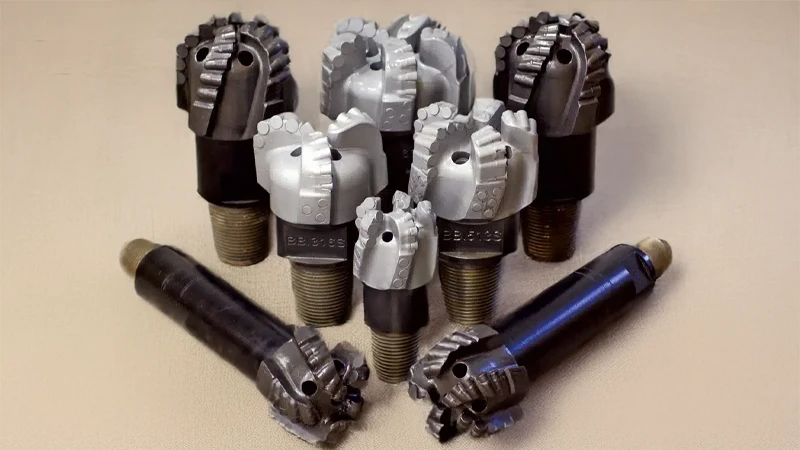
As we move through 2026, the global drilling industry is facing a dual-pressure environment: the skyrocketing demand for “energy transition” metals like copper and lithium, and the relentless drive toward automation. In this high-stakes landscape, the Rate of Penetration (ROP) has evolved from a mere performance metric into the ultimate survival factor for mining and exploration projects.
Every hour a rig stands idle or crawls through hard strata represents thousands of dollars in lost opportunity. While traditional drilling methods have served the industry for decades, 2026 marks a definitive shift. The PDC drill bit (Polycrystalline Diamond Compact), once reserved primarily for the oil and gas sector, has been re-engineered to dominate hard rock mining. This article explores why PDC technology is no longer an “alternative” but the gold standard for maximizing efficiency in the modern age.
The Physics of ROP: Why Shearing Beats Crushing
To understand how to maximize ROP, one must first understand the mechanical interaction at the rock face. For years, the industry relied on roller cone bits that utilized a “crushing and gouging” mechanism. This process requires massive amounts of Weight on Bit (WOB) to exceed the rock’s compressive strength.
However, the physics of the PDC drill bit is fundamentally different. Instead of crushing, it uses a shearing action. Imagine the difference between trying to break a block of wood with a hammer versus slicing it with a chisel. Shearing rock requires significantly less energy than crushing it.
The concept of Mechanical Specific Energy (MSE)—the energy required to remove a unit volume of rock—is key here. Because PDC bits shear the rock, they achieve a lower MSE, allowing the rig to convert more of its torque directly into footage. In 2026, with energy costs fluctuating, the ability to drill faster with less downward force is a competitive advantage that directly impacts the bottom line.
Material Science: The 2026 Standard for Diamond Composites
The reason PDC bits were previously avoided in hard rock was their tendency to fail under high temperatures or impact. However, the material science of 2026 has solved these legacy issues through two major breakthroughs:
- Deep Leaching Technology: Modern PDC cutters undergo a process where the cobalt binder is removed from the diamond table. This “leached” layer allows the cutter to withstand temperatures exceeding 800°C without suffering from thermal degradation.
- Impact-Resistant Interfaces: At Tianjin Good Drill CO.,LTD, we utilize a non-planar interface between the diamond table and the tungsten carbide substrate. This design dissipates shock waves more effectively, preventing the “chipping” that used to plague earlier generations of bits when hitting non-homogeneous formations or chert stringers.
These advancements mean that the “brittleness” of diamond is no longer a liability. Today’s composites are “tough” enough to handle the chatter of a DTH (Down-the-Hole) environment while maintaining the “hardness” required to stay sharp for miles of drilling.
Hard Rock Mastery: Breaking the 25,000 PSI Barrier
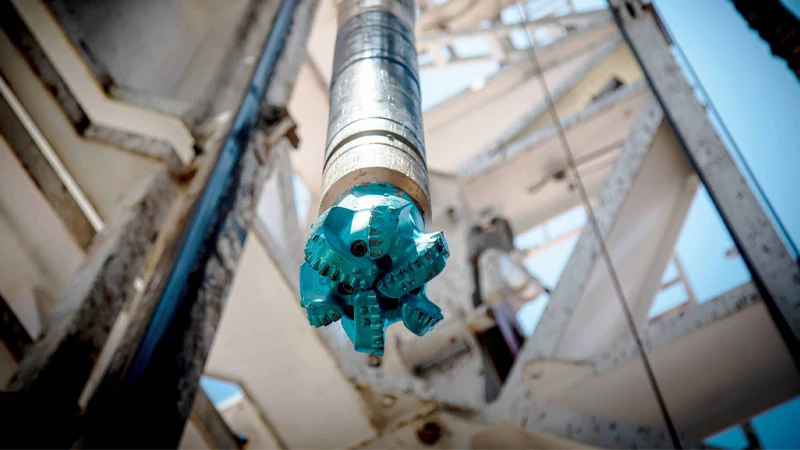
The most common question we receive is: “Can a PDC bit handle hard rock?” The answer in 2026 is a resounding yes. We are now successfully deploying PDC designs in formations with Unconfined Compressive Strength (UCS) exceeding 170 MPa (25,000 PSI).
To master these hard environments, the industry has moved toward 3D Shaped Cutters. Instead of flat discs, we now use conical or ridged “axed” cutters. These shapes concentrate the WOB onto a smaller surface area, allowing the bit to “plow” into high-PSI rock with ease.
Expert Tip for 2026: Maximizing ROP in hard rock isn’t just about the bit—it’s about the “sweet spot” of parameters. Based on field data, we’ve found that maintaining a high RPM (Revolutions Per Minute) while carefully monitoring torque fluctuations prevents the heat-checking that ruins bits. By using a PDC bit with an optimized back-rake angle (typically 15° to 25° for hard rock), operators can maintain stable drilling even in the most abrasive granite or basalt.
The Economic Equation: Total Cost per Foot vs. Initial Price
There is no denying that a high-quality PDC drill bit carries a higher upfront price tag than a standard tri-cone or carbide bit. However, 2026’s sophisticated project managers look at the Total Cost per Foot (TCPF), not the purchase price.
Consider the following ROI formula:

When you increase ROP by 30% to 50%, the “Drilling Time” in the numerator drops drastically. More importantly, because a PDC bit can often stay in the hole for the entire duration of a project (due to its extreme wear resistance), the “Trip Time” (the time spent pulling the drill string to change a dull bit) is virtually eliminated. In deep-hole applications, saving just one “trip” can pay for the cost of the PDC bit twice over.
Conclusion & The Tianjin Advantage
The verdict for 2026 is clear: The shift toward PDC technology is driven by the undeniable physics of shearing and the robust economics of increased ROP. As mining projects go deeper and construction timelines get tighter, the “old way” of crushing rock is simply too slow and too expensive.
At Tianjin Good Drill CO.,LTD, we don’t just provide tools; we provide drilling solutions. Our range of PDC Drill Bits, DTH Drilling Tools, and Drill Rods are engineered to work in a synchronized system, ensuring that every watt of power from your rig is translated into progress.
Whether you are tackling a geothermal project in high-temperature strata or a massive open-pit mine, maximizing your ROP starts with the right bit design.