
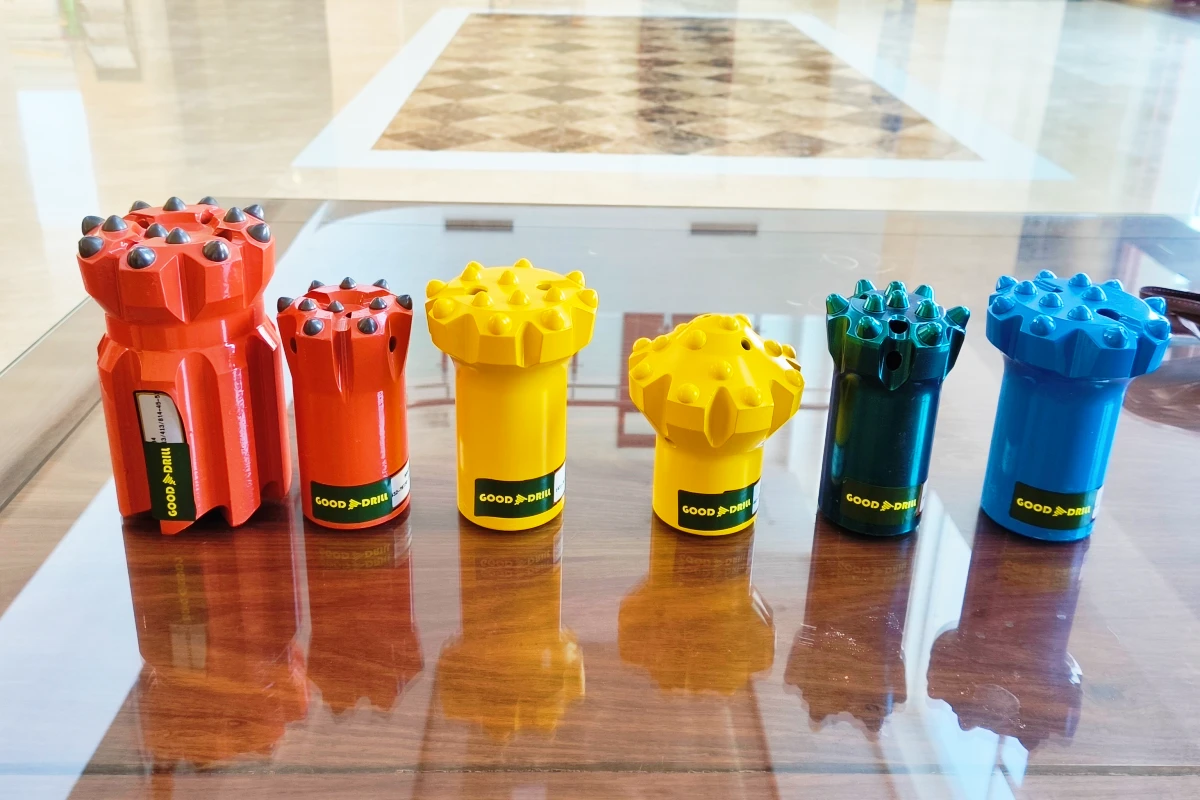
Tapered vs threaded drill bits should be selected by the complete drilling system—not by rock hardness alone. Start with the rock drill and rod connection, then check hole diameter, hole depth, impact level and ground conditions. A tapered bit is retained by a matching conical fit on a tapered rod. A threaded bit screws onto a compatible threaded rod and is normally used in a modular top-hammer drill string. If the connection does not match, no face design or carbide grade can rescue the order.
This distinction matters because a bit is only the front end of an energy-transfer chain. The rock drill creates impact energy; the shank and rod transmit it; the bit delivers it to the rock; flushing clears the cuttings. A mismatch at any connection increases energy loss, loosening, thread damage, premature wear or downtime. The practical question is therefore not simply, “Is the rock soft or hard?” It is: Which drill string can transfer energy reliably in this machine, hole and rock?
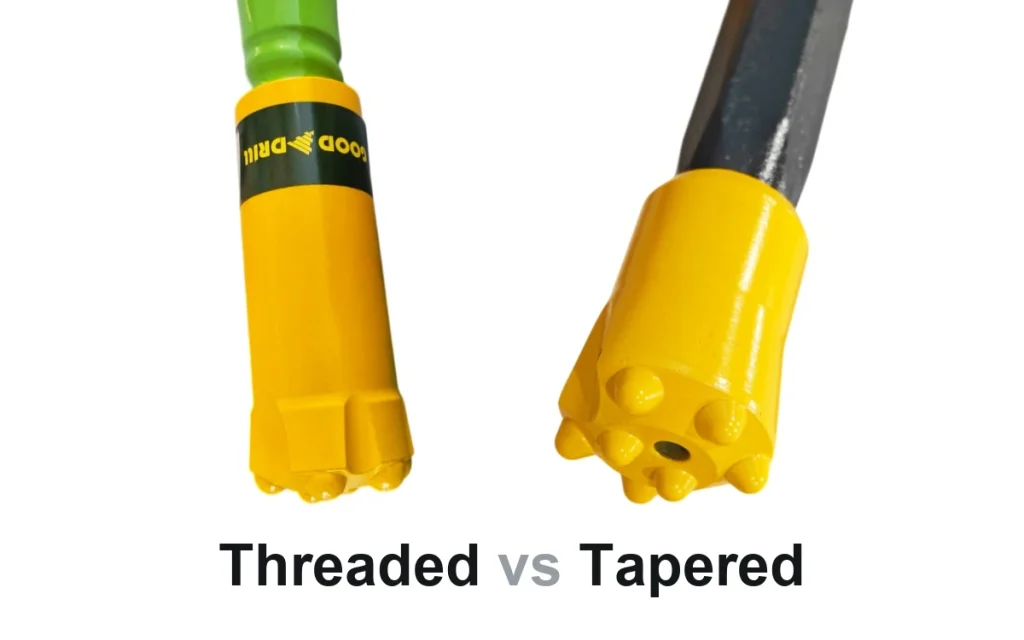
Tapered vs Threaded Drill Bits: Quick Comparison
| Selection factor | Tapered drill bit | Threaded drill bit |
|---|---|---|
| Connection | Internal tapered socket seats on a matching tapered rod | Internal thread screws onto a matching threaded rod |
| Typical drill string | Rock drill + tapered rod + tapered bit | Rock drill/shank adapter + threaded rod(s) + coupling where required + threaded bit |
| Common equipment | Handheld and air-leg rock drills; some mechanized tapered systems | Hydraulic or pneumatic top-hammer rigs, drifters and jumbos |
| Typical hole strategy | Shorter holes and simpler drill strings; exact capability depends on the taper and equipment | Modular strings, deeper holes and extension drilling where the rig and thread system permit |
| Changeover | Bit is driven onto the taper and removed with the correct tool | Bit is screwed on/off; thread condition and lubrication matter |
| Common connection families | 4°46′, 7°, 11° and 12° | R25, R28, R32, R38, T38, T45 and T51, depending on the product range |
| Key ordering risk | Wrong taper angle or poor taper contact | Wrong thread family, pitch, handedness or incompatible rod/bit dimensions |
| Best reason to choose | Existing drill uses a tapered system and the required hole fits that system | Existing rig uses a threaded top-hammer system or the job needs a modular, higher-capacity drill string |
This tapered vs threaded drill bits table is a starting point, not a substitute for the machine manual. Manufacturers publish different working ranges for different taper and thread systems. For example, Epiroc’s tapered drill-string data lists several tapered systems—from shallow, light-quarrying arrangements to 11° and 12° systems for harder rock and higher-impact drilling. That is why “tapered equals soft rock” is not a safe buying rule.
How Tapered vs Threaded Drill Bits Connect
A Tapered Bit Uses a Self-Holding Conical Fit
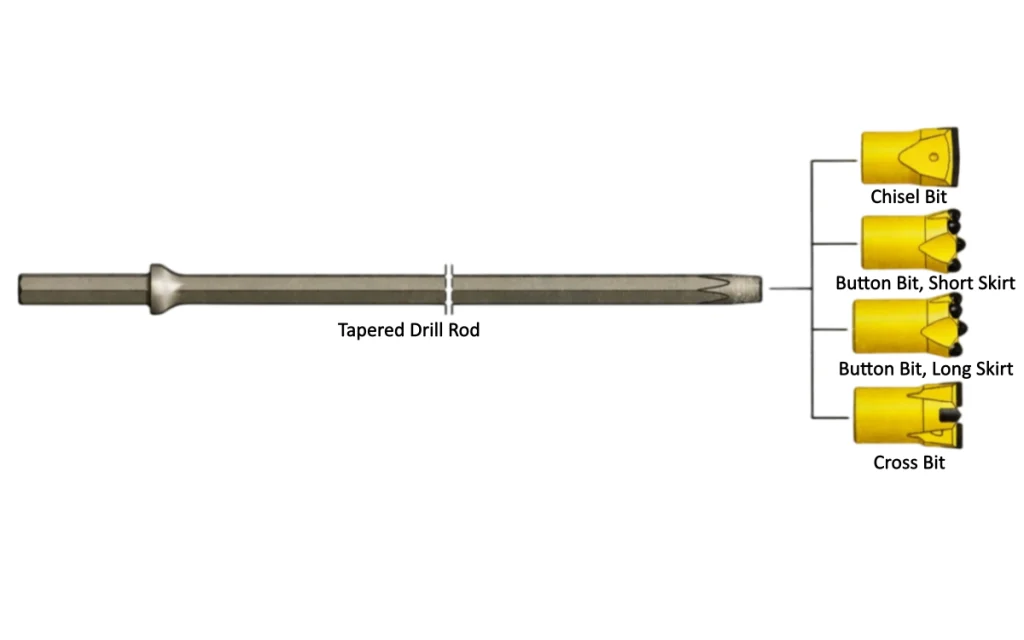
A tapered drill bit has a smooth internal socket rather than a screw thread. The socket must match the taper angle and dimensions of the rod nose. Under impact, the two conical surfaces seat together and transmit percussion and rotation.
This design keeps the drill string simple. It is widely associated with handheld and air-leg rock drills used in quarrying, small tunnels, construction and short-hole work. Good Drill’s public product range includes tapered button bits and matching tapered rods for common rock-drilling applications.
However, “simple” does not mean “universal.” A 7° bit should not be installed on an 11° or 12° rod. Even when two parts appear close, incomplete contact concentrates stress on a small area. The result may be a loose bit, damaged rod nose, difficult removal or early breakage.
Check before ordering:
- taper angle;
- rod shank/body size;
- bit diameter;
- bit type—button, cross or chisel;
- rock drill model and shank requirement;
- intended hole diameter and depth.
A Threaded Bit Becomes Part of a Modular Drill String
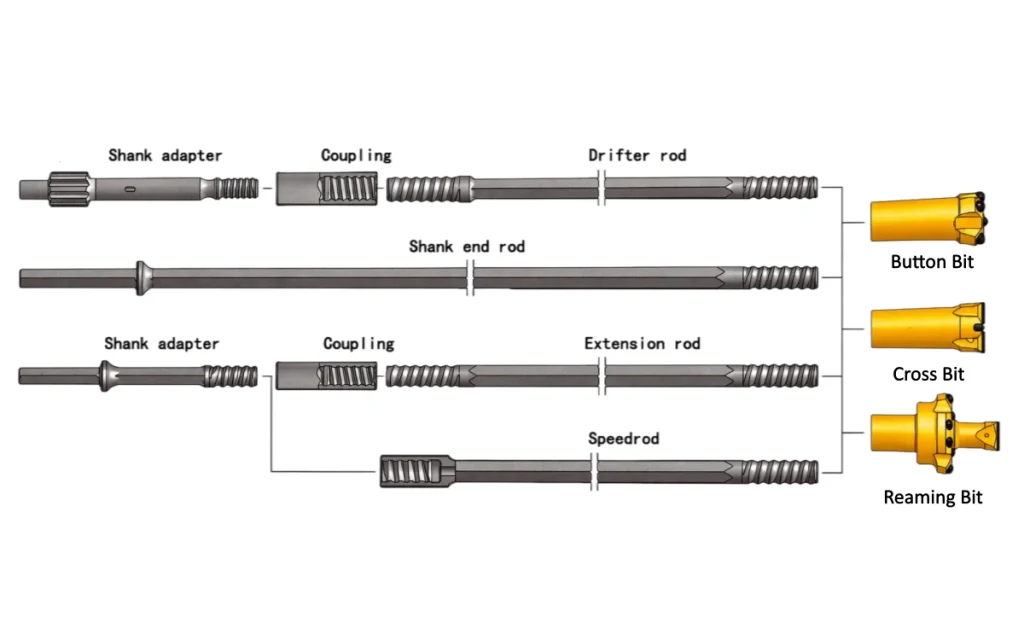
A threaded drill bit has an internal rock-drilling thread that screws onto the rod. Depending on the system, the drill string may also include a shank adapter, drifting rod, extension rod, guide rod and coupling sleeve.
The threaded architecture is valuable when the machine delivers higher impact energy, the hole must be extended with additional rods, or the application requires a more rigid and configurable drill string. It is common in mechanized top-hammer drilling for tunnelling, underground mining, bench drilling, quarrying and construction.
The connection must be exact. “R32” and “T38” are not interchangeable labels, and a bit should never be selected from diameter alone. The rock drill and shank adapter establish the connection family; the required hole establishes the bit diameter; the rock and drilling behaviour influence the face and button design.
Check before ordering:
- rock drill or drifter make and model;
- shank adapter and rod thread;
- rod type and length;
- bit diameter;
- bit face and button shape;
- air or water flushing arrangement;
- hole depth and whether extension drilling is required.
Do Not Choose by Rock Hardness Alone
A common rule says, “Use tapered bits in soft rock and threaded bits in hard rock.” It sounds convenient, but it leaves out the system that actually drives the bit.
Consider two sites:
- A quarry uses a heavy-duty handheld drill with a matched 11° tapered string in hard rock.
- A mechanized jumbo uses an R32 threaded string in medium-hard tunnelling rock.
The first site may correctly use a tapered bit in harder rock, while the second correctly uses a threaded bit in less severe rock. The decisive difference is not one hardness label. It is the rock drill, connection, impact energy, hole requirement and operating method.
In a tapered vs threaded drill bits comparison, rock condition still matters—but mainly after the connection system is fixed. It helps determine:
- bit face: flat, drop-centre, concave or retrac, where available;
- button shape: spherical for wear resistance and impact durability, or more aggressive profiles for faster penetration under suitable conditions;
- flushing: number and position of holes needed to clear cuttings;
- gauge protection: especially important in abrasive rock or fractured ground;
- operating settings: feed, rotation, percussion and flushing balance.
A bit that fits the rod but does not suit the ground may drill slowly or wear unevenly. A bit that suits the rock but does not fit the rod is unusable. Compatibility comes first; rock optimisation comes second.
How to Choose Tapered vs Threaded Drill Bits in 5 Steps
Step 1: Identify the Rock Drill and Drilling Method
Begin with the machine, not the bit catalogue.
If the site uses a handheld or air-leg rock drill, record the exact drill model and the rod already in use. This often leads to a tapered system, but the actual shank and rod must still be confirmed.
If the site uses a hydraulic jumbo, drifter or mechanized top-hammer rig, record the rock drill model, shank adapter and current thread. This normally leads to a threaded system.
Do not accept a broad answer such as “Atlas Copco drill” or “a pneumatic drill.” Product families contain different rock drills and shanks. Ask for the model plate, current rod marking or clear photos of both ends.
Step 2: Match the Connection Exactly
For tapered tools, confirm whether the rod and bit are 4°46′, 7°, 11° or 12°. Do not mix angles because the names look similar.
For threaded tools, confirm the thread marking—for example R32, T38 or T45—on the rod, bit or shank adapter. If the marking is missing, provide dimensions and photos rather than guessing.
A practical photo set includes:
- the complete old bit;
- the inside connection;
- the rod end;
- any stamped or engraved marking;
- a ruler or calliper in the same frame.
Step 3: Define Hole Diameter, Depth and Rod Strategy
Hole diameter determines the bit size, but hole depth determines much of the drill-string design.
When comparing tapered vs threaded drill bits for a short hole drilled with one rod, a matched tapered system may be the most straightforward choice when the machine supports it. For deeper holes requiring additional rods, a threaded system usually provides the modular connections needed for extension drilling.
This is a conditional rule, not an absolute depth limit. Taper angle, rod length, impact energy and manufacturer design all change the working range. Use the machine manual and the supplier’s specification table for the final decision.
Record:
- finished hole diameter in mm;
- hole depth per hole in m;
- drilling direction;
- rod length and number of rods;
- required straightness or deviation control.
Step 4: Describe the Rock as More Than “Hard” or “Soft”
Two rocks with similar compressive strength can wear bits differently. Tell the supplier whether the ground is:
- massive or fractured;
- abrasive or relatively non-abrasive;
- homogeneous or interbedded;
- wet, clay-bearing or likely to block flushing;
- associated with frequent bit jamming or hole deviation.
If available, provide the rock type, UCS value or a clear site description. Granite, basalt, limestone and shale are helpful starting points, but site behaviour is more useful than a name alone.
Step 5: Compare Cost per Metre, Not Only Bit Price
Price alone should not decide between tapered vs threaded drill bits. The lowest-priced bit is not automatically the least expensive drilling choice. Compare:Bit cost per metre=metres drilled before replacementbit purchase price
Then add the operational costs that matter on site:
- downtime during bit changes;
- damaged rods or couplings;
- re-drilling caused by deviation;
- grinding or maintenance cost;
- slower penetration;
- lost hole diameter from gauge wear.
Run a controlled field trial when changing systems or suppliers. Keep the machine, hole pattern and operating settings as consistent as possible. Record penetration rate, metres drilled, wear pattern and failure mode. A trial makes the purchasing decision measurable instead of subjective.
Tapered vs Threaded Drill Bits Decision Matrix
| Site condition | Likely direction | What must be confirmed before ordering |
|---|---|---|
| YT-series air-leg drill, one short rod, small production holes | Usually tapered | Drill model, shank, taper angle, rod size, bit diameter |
| Heavy-duty handheld quarry drilling with an existing 11° string | Tapered may remain appropriate | Exact 11° compatibility, impact level, hole diameter, wear pattern |
| Hydraulic jumbo with R32 rods | Threaded | Rock drill/shank adapter, R32 variant, rod length, bit diameter and flushing |
| Bench drilling that needs extension rods | Usually threaded | Thread family, coupling/rod plan, hole depth, deviation and flushing |
| Buyer only provides “38 mm bit” | Insufficient information | Connection, machine, rod, rock, hole depth and flushing |
| Hard, abrasive rock but the current tapered system is correctly matched | Do not change system automatically | Review face/button design, gauge wear and actual cost per metre first |
| Frequent loosening or damaged connections | Diagnose before reordering | Taper contact or thread wear, feed/rotation settings, part compatibility and handling |
Avoid These Six Ordering Mistakes
1. Ordering by Diameter Alone
Diameter alone cannot settle a tapered vs threaded drill bits decision. A 38 mm tapered bit and a 38 mm threaded bit may make the same nominal hole, but their connections and drill strings are completely different.
2. Treating Every Taper as Interchangeable
The taper angle is a functional dimension, not a marketing label. Mixing 7°, 11° and 12° components can reduce contact and concentrate impact stress.
3. Confusing Rock-Drilling Threads with General Fastener Threads
Rock-drilling R and T threads are designed for percussive loads and flushing. A description such as “threaded bit” is incomplete without the actual thread family.
4. Choosing the Bit Before Identifying the Rock Drill
The machine and shank adapter determine the energy path and connection. Starting with a preferred bit often forces the wrong rod or adapter downstream.
5. Ignoring Flushing
Poor cuttings removal can look like a bit-quality problem. Confirm whether the system uses air or water, the available flow, the flushing-hole layout and whether the ground produces sticky cuttings.
6. Comparing Purchase Price Without Recording Metres Drilled
Without metres, penetration rate and wear pattern, a buyer cannot distinguish a low-cost bit from a low-cost-per-metre bit.
Send These Details for a Reliable Recommendation
A useful RFQ for tapered vs threaded drill bits should include more than “Please quote drill bits.” Send the following job card:
| Required information | Example of a useful answer |
|---|---|
| Rock drill/rig | Brand and exact model; photo of model plate |
| Current system | 11° tapered rod, or R32/T38/T45 threaded string |
| Existing part | Photos and markings from the old bit and rod |
| Hole diameter | 38 mm, 64 mm, etc. |
| Hole depth | Depth per hole and number of rods used |
| Rock/ground | Rock type, UCS if known, abrasive/fractured/wet conditions |
| Drilling direction | Horizontal, downward, upward or inclined |
| Flushing | Air or water; known flow/pressure where available |
| Current problem | Slow penetration, gauge wear, loose bit, thread damage or breakage |
| Quantity and destination | Trial and regular quantity; destination country/port |
With this information, Good Drill can first check compatibility, then narrow the suitable bit design. This makes the tapered vs threaded drill bits recommendation traceable to the machine and job conditions. If a field result is uncertain, the responsible answer is a trial plan—not an unsupported performance promise.
Tapered vs Threaded Drill Bits FAQs
Can I Replace a Tapered Drill Bit with a Threaded Drill Bit?
Not on the same rod. The connections are structurally different. Changing from tapered to threaded normally requires a compatible drill string and may require a different shank adapter or rock drill arrangement. Confirm the complete system before conversion.
Are Threaded Drill Bits Always Better for Hard Rock?
No. Threaded systems are often used with higher-capacity mechanized top-hammer rigs, but correctly selected tapered systems can also work in hard rock. First match the machine and connection; then optimise the face, buttons and flushing for the rock.
Can a 7° Bit Fit an 11° Tapered Rod?
No. The taper angles should match. A near fit is not a correct fit and can lead to poor contact, loosening, concentrated stress or damage.
Which System Is Better for Deep Holes?
Threaded systems are usually preferred when holes require extension rods and a modular drill string. The final choice still depends on the rig, thread family, rod plan, hole diameter and deviation requirement.
How Do I Identify an Unknown Threaded Bit?
Look for markings first. If none are visible, provide photos, major dimensions, thread profile measurements, the matching rod and the rock drill model. Do not identify a rock-drilling thread from outside diameter alone.
Is a Tapered Drill Bit Cheaper Than a Threaded Bit?
Purchase price depends on size and design. Tapered systems can be simpler, but the meaningful comparison is cost per metre, including life, penetration, downtime and damage to other drill-string components.
What Information Is Most Important for a Quotation?
Provide the rock drill model, current connection, required hole diameter and depth, rock conditions, flushing method, quantity and destination. Photos of the existing bit and rod sharply reduce the risk of a wrong order.
Make the Connection Decision Before the Product Decision
The visible difference between tapered vs threaded drill bits is simple: a tapered bit has a conical socket, while a threaded bit has an internal rock-drilling thread. The purchasing decision is more demanding. Choose the drill-string architecture first, verify the exact connection second, and optimise the bit for the hole and ground third.
If you are replacing an existing bit, send photos of the bit, rod end and markings. If you are designing a new drilling setup, send the rock drill model, target diameter, hole depth and rock conditions. Good Drill can then review the complete connection chain instead of guessing from one measurement.